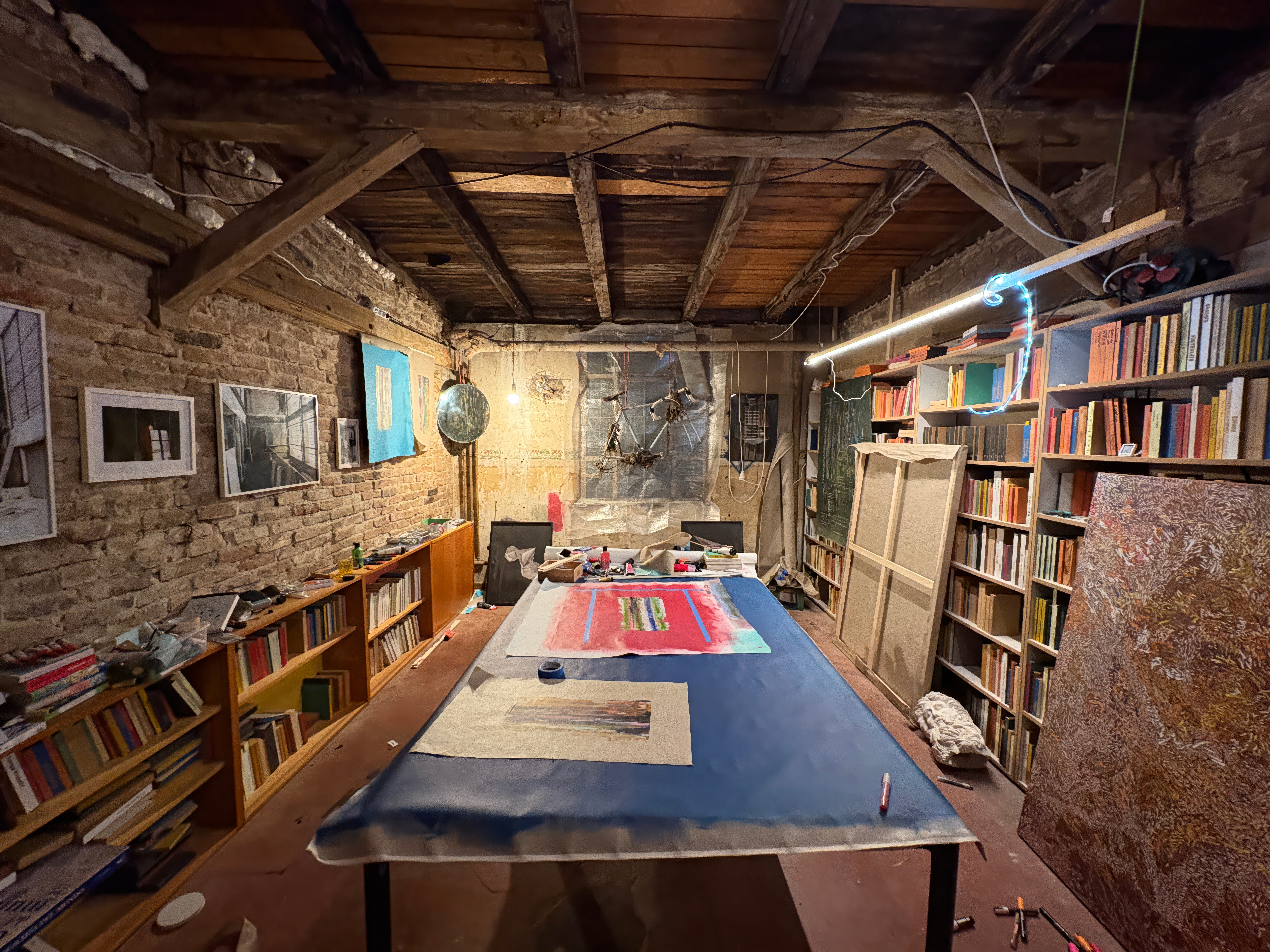
I planned to build the bathroom and seal a room partially to avoid the freezing temperatures of Berlin’s winter. I received the rental agreement for my studio (now also home of Curiosity Labs) exactly one year ago in January 2025. There was no electricity or running water.
After coming back from Mexico City in New Year’s Eve 2025, I checked into a hotel for a night before starting the renovations. That night marked the beginning of a great future ahead. It also gave me back the cyclical temporality associated with the new year that I had already lost. For various reasons, including the pandemic, the passing of years had been erased into a big chunk of time.
That recovered spirit of renewal incites me today to write this text accounting for this passing year and welcoming the following. This year, however, I won’t start anew. Rather, and borrowing this from the German expression “guten Rutsch ins neue Jahr”, I’ll slide into the next one with hope to give order to the multiple and prolific “lines of flight” brought with this year of vivid images, suggestive dreams, and fertile possibilities. After structures break, new reconnections, vectors and creative efforts are needed to find new and unexpected forms of living. This is at the core of Deleuze’s and Gutarri’s thinking. In this sense, life, thinking, and art practices are mechanisms of “fuga” or escape.
It is a problem of thermodynamics too. After intense times of expansion, fluidity, and agitation, things tend to reorder, stabilise, slow, or fall down, forming vortexes or creating sediments.
That night, at the hotel in Mitte, I realised that just across the street stood a hostel where I had stayed during my very first visit to Berlin, 27 years ago, in 1998, when I first fell in love with the city. It was after a visit to Tacheles and a walking tour of Berlin. Such a cliché! But Tacheles, and I mean of course the old 90’s Tacheles, once home to creative squatters and artists, was an important inspiration for me to become an artist, and eventually to move to Berlin. Sadly, the iconic building is now a façade concealing super-commodified living, commercial and cultural spaces, that although interesting, they lack the experimental spirit and sense of freedom of Berlin in the 90’s. My visits to Berlin in those years were brief, but fundamental to my career.
I managed to build the bathroom walls and install a sink and a toilet in my studio, in the first two weeks of January. It was very precarious, but I felt confident that I could secure a semi-comfortable space before travelling back to Mexico: “wishful thinking”, would say my mother. I was perhaps delusional, or at best, blinded by that sense of heroism that comes from pushing yourself to extreme situations and challenges. I missed the feeling of climbing mountains in Mexico. This was similar. It was exciting and strenuous. But also absurd, which is a familiar feeling within art processes.
I did not manage to insulate a working studio/bedroom before flying back to the intense heat of the Mexican rainforest and continuing with the research and production of Estelas del Usumacinta exhibition at the Museo Amparo. I couldn’t build the door or insulate the windows and walls for the bedroom. Effort alone was not enough.
My therapist helped me to put things into perspective: “—You did not sit at the negotiating table with General Winter, also known as Russian Winter or General Frost”. He was referring to the harsh conditions that helped the Russian armies to win against both Napoleon and, later, the Germans during World War II. Winters win wars. He was right. I thought about winter, but I overestimated it. The cold in Berlin is hard. It is not because of the temperatures but because of its damp and grey spirit. It’s long-lasting and consistently monotonous.
I couldn’t heat a single room. I lost the battle. I spent hours thinking about heat and cold, planning to design and build insulated modules inside the studio—like establishing a base camp in outer space. Insulation is about producing spaces that are deliberately disconnected from their surroundings, minimising air exchange. A heated space must be separated, as much as possible, from the outside world, much like the closed systems imagined or engineered in thermodynamics under conditions that rarely, if ever, exist in nature.
Being well-informed and considering heat is a thermal activity in itself, but without action, it does little to regulate temperature. Thermodynamics are relentless. Heat disperses. Entropy increases. Always. Cold things cannot produce heat. These principles, implied in the elusive second law of thermodynamics, are well embodied in almost every physical, human, and planetary entity, including time itself.
The battle to regulate heat is perhaps the most vital in the Universe. Every calorie we ingest adds to the effort to resist our own heat loss and death. Unlike my studio, which needs insulation, we sustain thermal equilibrium by exchanging energy with the environment. We are marvellous machines. But in thermodynamics, the scale is important too, and heat is embodied in various layers and temporalities, from the microscopic to the cosmic, including human bodies and the walls of my studio, to weather patterns and climate change. At the atmospheric level, heat regulation and homeostasis, what Lynn Margulis and James Lovelock called Gaia, is probably the biggest challenge of our times. Climate change is the thermal event of greatest importance.
I try to stay positive. I propose thermal thinking as a more careful, collective and bodily form of thinking, where energy is partially conserved through dialogue and exchange with the environment. But energy has a strong tendency to disperse. Things that have form (at least what we understand as form) tend to lose it. Patterns disappear, and heat is lost. They say that the Universe will eventually reach its heat death, a state of maximum entropy governed by random processes. I don’t know if that is the case. But at least tonight, we celebrate with fireworks, dispersing —wasting perhaps— heat into the atmosphere.
At least, spring is closer.